The world of marketing technology is often a graveyard of broken promises and automated workflows that break at the worst possible moment. If you manage a team that relies on social media to drive revenue, you know the specific feeling of dread when you realize the API disconnected three hours ago and your sales team is chasing leads that don’t exist—or worse, ignoring ones that do. This is the silent killer of digital growth, and it is where the conversation surrounding updates on software socials aliensync has sparked intense curiosity and confusion across multiple digital sectors .
The search term appears to be a digital Rorschach test. Depending on who you ask, it represents a new social media management suite, a tech-aggregator website, or a sophisticated synchronization protocol for enterprise data. While a singular, authoritative definition remains elusive, the surge in interest signals a genuine market demand for better integration between chaotic social data and rigid business software . This article cuts through the noise to explain what these updates actually entail, why the term has become so ambiguous, and what the future holds for digital synchronization.
Table of Contents
The Two Faces of AlienSync: Content Hub vs. Integration Protocol
To understand the current landscape, you have to separate the conceptual from the corporate. There is no Fortune 500 company named “AlienSync” with a clear product roadmap. Instead, the term describes two distinct realities happening simultaneously .
First, there is the AlienSync Digital Hub. This operates primarily as a content publishing platform focused on tech news and software reviews. It functions as a discovery engine, helping users find niche applications and tools. The “updates” in this context refer to new articles, curated lists, and community discussions about the “best apps” for specific needs .
Second, and far more intriguing for business professionals, is the AlienSync Synchronization Protocol. This is a methodology rather than a specific product download. It refers to a strategic approach to connecting social media platforms with Customer Relationship Management (CRM) systems and Enterprise Resource Planning (ERP) software . The interest here is purely operational: how do you stop data from getting lost between the social ad platform and the sales pipeline?
This duality is the primary source of the ambiguity. When users search for updates on software socials aliensync, they are essentially asking for information from two overlapping yet distinct ecosystems.
Why the Sudden Surge in Interest for Software Socials Updates
Interest in synchronization tools has never been higher, largely because the cost of doing nothing has become too high. Businesses are losing money due to “data decay” and “integration tax” .
The core pain point is fragmentation. Companies today use an average of over 100 different applications. When your marketing stack doesn’t communicate effectively, you bleed revenue. For instance, consider the “B2B scenario” highlighted by industry analysts: a viral post generates thousands of leads, but the standard native connectors fail under the load. The sync breaks, leads sit in a CSV file for four days, and when they finally reach the sales rep, they are cold .
The search for updates on software socials aliensync is often driven by marketing operations managers looking for a solution to this exact problem. They aren’t necessarily looking for a specific app; they are looking for a better “integration matrix” that handles volume, automates deduplication, and routes leads instantly . As the operational tax of middleware continues to rise, teams are seeking more robust architectures to protect their ROI.
What the Software Socials Landscape Actually Looks Like Today
While the brand name “AlienSync” remains loosely defined, the features commonly attributed to it represent a “wish list” for modern marketers. The “feature set” often discussed includes several core functionalities that are now considered table stakes in the industry .
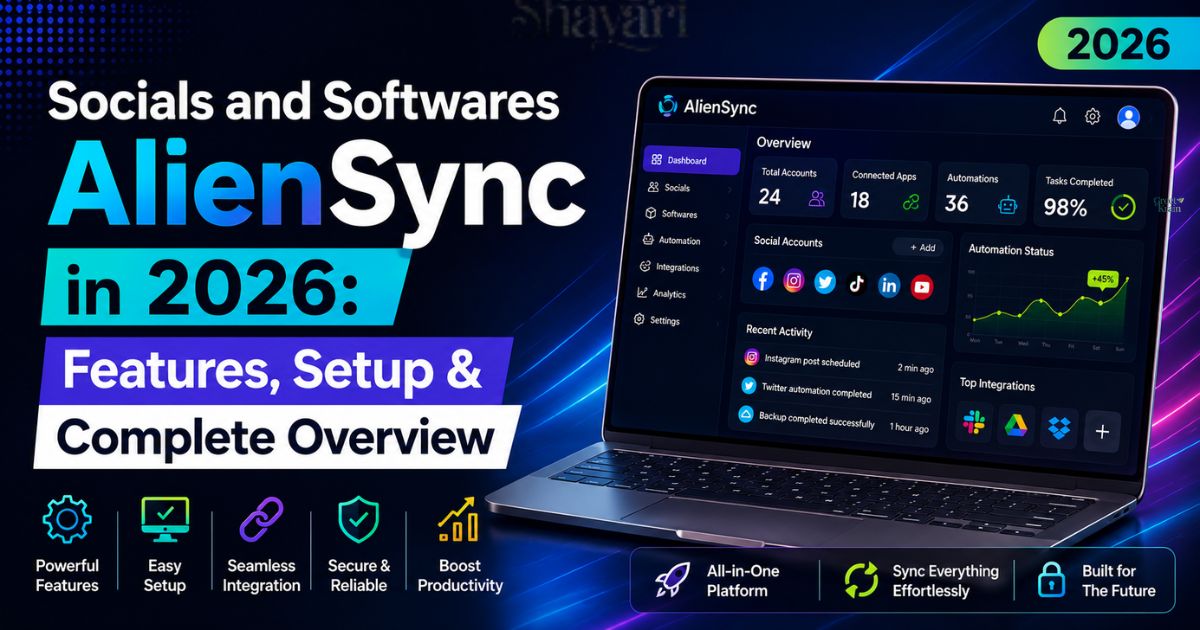
A primary feature is the Unified Social Dashboard, which allows users to connect platforms like TikTok, X (formerly Twitter), YouTube, and Instagram. The goal is to eliminate tab switching . Another major component is the Social Card, or digital identity hub. This allows content creators to unify their links, portfolio, and bio in one place, which is becoming essential for personal branding and influencer management .
However, the most revolutionary aspect is the concept of the Multi-Platform Content Manager. Instead of writing a post five times, teams write once and schedule it across all networks. The promise here is massive time savings, with some tools claiming to reduce scheduling time by 98% . Tools that offer these capabilities are the ones currently winning in the market.
The Enterprise Reality: Synchronization vs. “Sync-Washing”
For large organizations, the term “updates on software socials aliensync” triggers a very specific mental image: the “Architectural Alignment” problem. This is the unglamorous work of payload mapping and data normalization.
When a social platform sends a lead’s phone number as a string of integers, but your CRM requires specific formatting, the system breaks. This is the reality of “garbage in, garbage out” . A genuine synchronization tool provides a “staging environment” where data is “queued” and “normalized” before being pushed to the live CRM.
The market is currently shifting toward “Zero-Copy Integration.” This means that instead of copying huge amounts of data from one database to another, you query it across systems. This reduces lag and cuts down on the massive costs associated with API calls. The companies that figure this out stop paying exorbitant middleware fees and build custom ETL pipelines that cost a fraction of a cent per lead .
Future Outlook: The Age of Seamless Connectivity
Looking forward, the specific brand name “AlienSync” may fade, but the need for it will only grow. We are moving toward a “Connected Operations” model where social media data isn’t just a vanity metric but a core part of the sales trigger.
Emerging trends point toward the use of AI to auto-correct data mismatches. If a lead enters the system with an incorrect field, the AI will fix it automatically based on historical data . Furthermore, the integration of “Blockchain” for data security is being explored, though still in its infancy for these specific workflows .
The biggest shift will be the move away from per-task pricing. We will likely see a rise in “Result-Oriented” pricing, where you pay only when a lead is successfully converted, rather than for every individual step in the workflow. This shifts the risk from the buyer to the software provider, forcing vendors to ensure their syncing actually works.
Key Takeaways
- Dual Identity: “AlienSync” refers to both a tech content hub and an operational synchronization strategy. Users must identify their specific use case to find relevant updates .
- Volume Fails Native Connectors: Standard social media integrations break under high-volume traffic (like a viral post), causing businesses to lose leads .
- Pay Attention to Payloads: Lost revenue is often due to data formatting mismatches between social platforms and CRMs, requiring a robust normalization layer .
- The Integration Tax is Real: Middleware costs can balloon to thousands of dollars per month as you scale; advanced teams are moving to custom serverless functions .
- Time Savings: The primary tangible benefit of current software socials tools is the reduction of manual scheduling and reporting time, with some tools claiming savings of up to 98% .
Frequently Asked Questions (FAQ)
Is AlienSync a new social media network?
No. Based on current data, AlienSync is not a destination platform like Facebook or X for personal status updates. It is either a tech-aggregator that reviews other platforms or a conceptual synchronization tool designed to manage existing accounts .
What does “software socials” actually mean in this context?
It refers to the intersection of software tools (like CRMs) and social media management. It also represents a community hub where software is discussed and vetted by users .
Is AlienSync related to blockchain technology?
Some descriptions claim AlienSync utilizes blockchain for data synchronization and transparency. However, these appear to be internal architectural claims rather than a public-facing cryptocurrency project .
Why are native social media integrations failing businesses?
Native integrations are inflexible. They assume your business operates within a specific framework and cannot handle sudden high-volume spikes or complex data mapping, leading to broken syncs and lost leads .
How can I ensure my social data syncs correctly?
You need to implement a staging area or normalization layer. This means intercepting the raw data from the social API, cleaning the text strings, formatting them to match your CRM, and then pushing it to the database .
What is the “integration tax”?
The “integration tax” refers to the hidden cost associated with per-task pricing on middleware platforms. As you scale, processing thousands of leads through these services becomes prohibitively expensive .
Conclusion
The conversation around updates on software socials aliensync reveals a market desperate for a cure to digital fragmentation. While you may not be able to download a specific “AlienSync” program, the principles it represents—unified dashboards, seamless data normalization, and enterprise-grade synchronization—are exactly what modern businesses need to survive. The goal is clear: turn messy social signals into clean, actionable, and timely sales data.
Don’t let broken workflows drain your marketing budget. Audit your current data integration strategy today. Identify your failure points, map your data payloads, and start building a robust architecture that can handle the volume of tomorrow. Are you ready to sync your operations?