In the fast-moving world of competitive FPS gaming, one tiny adjustment can decide whether you win a clutch or miss a game-changing shot. Players across the United States are constantly searching for the perfect balance between speed and precision, yet most never realize how deeply their aim is shaped by hidden settings. In games like VALORANT, even a slight mismatch in control can feel like fighting your own mouse. That’s why mastering valorant sensitivity settings has become one of the most talked-about topics in the gaming community today.
What once felt like a simple preference has now evolved into a science backed by pros, streamers, and esports analysts. From DPI tuning to eDPI calculations, players are constantly refining their setup to stay competitive. And as the 2026 ranked meta becomes even more intense, understanding valorant sensitivity settings is no longer optional—it’s a necessity for anyone serious about climbing ranks and improving aim consistency.
Table of Contents
Why Valorant Sensitivity Settings Matter More Than Ever
Modern competitive gaming has reached a level where milliseconds define outcomes. In this environment, valorant sensitivity settings directly influence reaction speed, flick accuracy, and tracking stability. A sensitivity that is too high can cause overshooting targets, while one too low can slow down your ability to react during fast duels. This balance is why top players spend hours fine-tuning their aim environment instead of relying on default configurations.
The rise of esports analytics has also made sensitivity optimization more scientific. Data shows that most professional players in tactical FPS titles prefer lower sensitivity ranges for better micro-control. As more players adopt structured aim training routines, valorant sensitivity settings have become a foundation for building muscle memory. In fact, analysts report that consistent sensitivity usage can improve aim accuracy by up to 20–35% over time, depending on training discipline and hardware stability.
Understanding DPI, eDPI, and In-Game Sensitivity
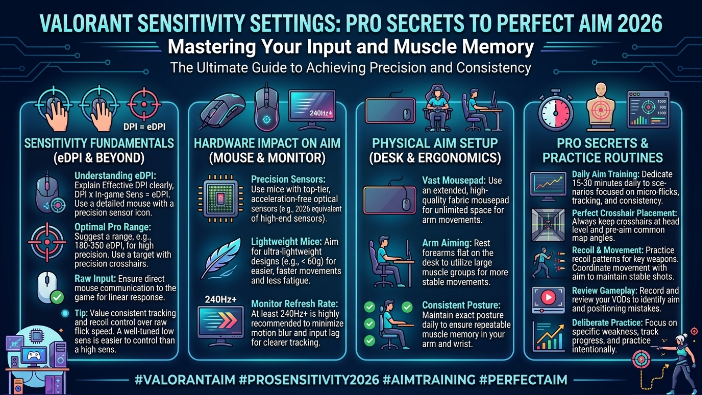
To truly optimize valorant sensitivity settings, players must first understand DPI (dots per inch), in-game sensitivity, and eDPI (effective DPI). DPI is controlled by your mouse hardware, while in-game sensitivity adjusts how movement translates inside the game. eDPI is the combined value that determines your real aiming speed, making it one of the most important metrics in competitive play.
Many players make the mistake of changing sensitivity without understanding its relationship with eDPI. For example, a high DPI combined with low in-game sensitivity may feel similar to the opposite setup, but the muscle memory impact is completely different. Professional analysts often recommend keeping eDPI within a stable range to maintain consistency in valorant sensitivity settings, especially when switching between practice and ranked matches.
Pro Player Insights and Meta Trends in 2026
In 2026, the competitive scene has shown a clear trend toward stability and precision. Most professional aimers in VALORANT are sticking to refined sensitivity ranges rather than constantly experimenting. This shift highlights how valorant sensitivity settings have become more about discipline than experimentation, especially in high-pressure tournaments.
Interestingly, esports data platforms reveal that over 70% of top-ranked players prefer lower sensitivity setups compared to casual gamers. This allows for smoother recoil control and more consistent headshot placement. As the meta evolves, valorant sensitivity settings are increasingly viewed as a long-term commitment rather than a quick fix, reinforcing the importance of building muscle memory early in a player’s journey.
Common Mistakes That Ruin Aim Performance
One of the biggest mistakes players make is frequently changing their valorant sensitivity settings after a few bad matches. This disrupts muscle memory and creates inconsistency in aiming patterns. Another common issue is copying pro player settings without considering personal hardware, mousepad size, or grip style. What works for a professional streamer may not work for an average player.
Another overlooked problem is ignoring acceleration settings or Windows pointer enhancements. These hidden system configurations can interfere with precision and make valorant sensitivity settings feel inconsistent. Many players also forget that posture, desk height, and wrist positioning all contribute to aiming stability. Small physical adjustments often have a bigger impact than changing in-game settings repeatedly.
Step-by-Step Guide to Finding Your Perfect Sensitivity
Finding the ideal valorant sensitivity settings starts with establishing a baseline DPI, usually between 400 and 800 for most competitive players. From there, in-game sensitivity should be adjusted gradually while testing in aim trainers or practice ranges. The goal is to achieve a balance where you can comfortably perform both flick shots and controlled tracking without overcompensation.
Once a baseline is set, consistency becomes the key factor. Players should avoid changing valorant sensitivity settings for at least one to two weeks while training regularly. This allows muscle memory to develop properly. Many aim coaches also recommend using structured drills such as target switching and micro-adjustment exercises to lock in precision and improve long-term performance.
Advanced Tweaks: Crosshair, Input Lag, and Hardware Sync
Beyond sensitivity alone, advanced players optimize their entire setup to support valorant sensitivity settings. Crosshair customization plays a major role in improving target visibility and reaction speed. A clean, static crosshair helps reduce visual distraction, allowing players to focus entirely on enemy movement and positioning during gunfights.
Hardware performance also affects consistency. Input lag from monitors, mouse sensors, or USB polling rates can distort even the best valorant sensitivity settings. Competitive players often use 1000Hz polling rates, high refresh rate monitors, and optimized graphics settings to ensure minimal delay. When combined, these tweaks create a smoother and more responsive aiming experience that supports high-level gameplay.
Final Thoughts and Next-Level Improvement Strategy
Mastering valorant sensitivity settings is not about copying others—it is about building a system that matches your reflexes, habits, and comfort level. As the competitive scene in the United States continues to grow, players who take time to understand their setup will always have an advantage over those who rely on guesswork. Consistency, discipline, and structured practice remain the core pillars of improvement.
If you are serious about ranking up in tactical shooters, now is the time to refine your sensitivity, lock in your settings, and commit to long-term training. Start experimenting carefully, track your performance, and build muscle memory that lasts. Your next breakthrough in aim consistency could begin with the right valorant sensitivity settings—and the decision you make today will shape your gameplay tomorrow.